Showing posts with label choir. Show all posts

Tuesday, 8 April 2025

Magdalena Žilinskaitė Aukštakalnienė - A life of song


It seems that Magdutė life was one of music and song.  A soloist and choir member, mezo soprano, she was born and raised in Kaunas. A member of St. Michael the Archangel's Church and Kaunas Basilica choir.

She joined the Lithuanian National opera choir and when an operetta was created she was accepted as a soloist. During the summer, when theatre groups toured Lithuanian cities she was amongst the them.

Towards  the end of WWII, Magdute moved to Germany.  She found the emerging Čiurlionis ensemble members and immediately joined their work.  There was no camp in Germany that the Čiurlionis ensemble did not visit and stir a deep love of Lithuanians in their hearts with their concerts.  The ensemble's travels were not easy, as they had to travel hundreds of kilometres by freight trains and military trucks. The Čiurlionis members did not complain of these tiresome trips, and Magdutė also never complained about her hard part.

She boarded the General Stewart ship arriving in Australia on 13 April 1949. She was to work at the Victorian Railways at Seymour, Victoria.

She married Lithuanian Pranas Aukštikalnis in Australia soon after arriving and had two children.  

Magdutė participated in the Melbourne Lithuanian community, there was no shortage of her anywhere - in celebrations and preparations, not only with her singing, but also with her extremely lively mood, it seems that she was born for that, to make others happy and entertained.  She was always alive, energetic, cheerful and friendly . She had an extraordinary love for Lithuanian youth.

Magdutė joined the Melbourne Lithuanian choir and sang whener asked, annual concerts, various commemorations, song festivals, Melbourne women's sextet and on Sundays St. John's Church.  She participated in all the song festivals around Australia.

She was buried on 22 January, having passed away four days previously.  Buried in Cheltenham cemetery, Melbourne where a  large number of the Melbourne community came to pay their respects. Members of the Melbourne Lithuanian choir, dressed in national clothes, stood on either side of the coffin as she made her final earthly journey.

Friday, 21 February 2025

Algimantas Plūkas

Algimantas Plūkas was born on New Year’s Day 1922 in Kupiškis. He is the son of Ignas and Julija Aleknaite.  He attended primary school in Kupiškis from, 1936-1942. studied at Kupiškis gymnasium.  In the summer of 1944, he left Lithuania for Germany, he had been studying electronics and residing in Vilnius before he left.  He had hoped to migrate to Cleveland. On 30 October 1949 emigrated to Australia on the Nelly and settled in Sydney.

He worked in a private company as a silversmith. His work is held by the Australian Officers' Association in Sydney (miniature cannon valued at about $4,000), Cardinal Gilroy of Sydney (several).

He devoted a lot of energy, time, financial resources and energy to Lithuanian affairs, he was a accordion player, conductor, instrumentalist, painter and decorator.  He carved wood, worked in metal.  He led the Sydney Lithuanian choir, Dainava from 1955 to 1957.  From 1960 to 1963 he led a double quartet, Rožytes, a double trio, the Merry Brothers. He wrote songs for scouts and guided groups. He illustrated Ava Saudargienė's book Sigutė (1968). He created a national dancing group called Plūktetas.

Algis joined the scouts in 1932 and gained his senior scout level in 1943. In Australia, he was a long-time member of the Sydney Lithuanian scout troop, Aušra and scouter leader. In 1952 he completed the Australian Scout Leaders Course, receiving the rank of Scoutmaster.  He participated in the 1938 national scout camp in Panemunė, Lithuania and led the Lithuanian scouts in the 1952-1953 Pan-Pacific Jamboree at Greystanes, NSW and almost every Aušra camp and district camp while in Australia.  Algis was an irreplaceable camp cook, musician and artist.  Camp songs composed by him are still sung today. For several years he illustrated the scout journal Pėdsekis.

He has been awarded the badge of the Tėvynės Sūnaus žymeniu Son of the Fatherland and the ordinu Už Nuopelnus Order of Merit for her services to scouting.

     Algis passed away on 11 June 1976 in Sydney. He has been interned in the Lithuanian section of Rookwood cemetery, Sydney. 

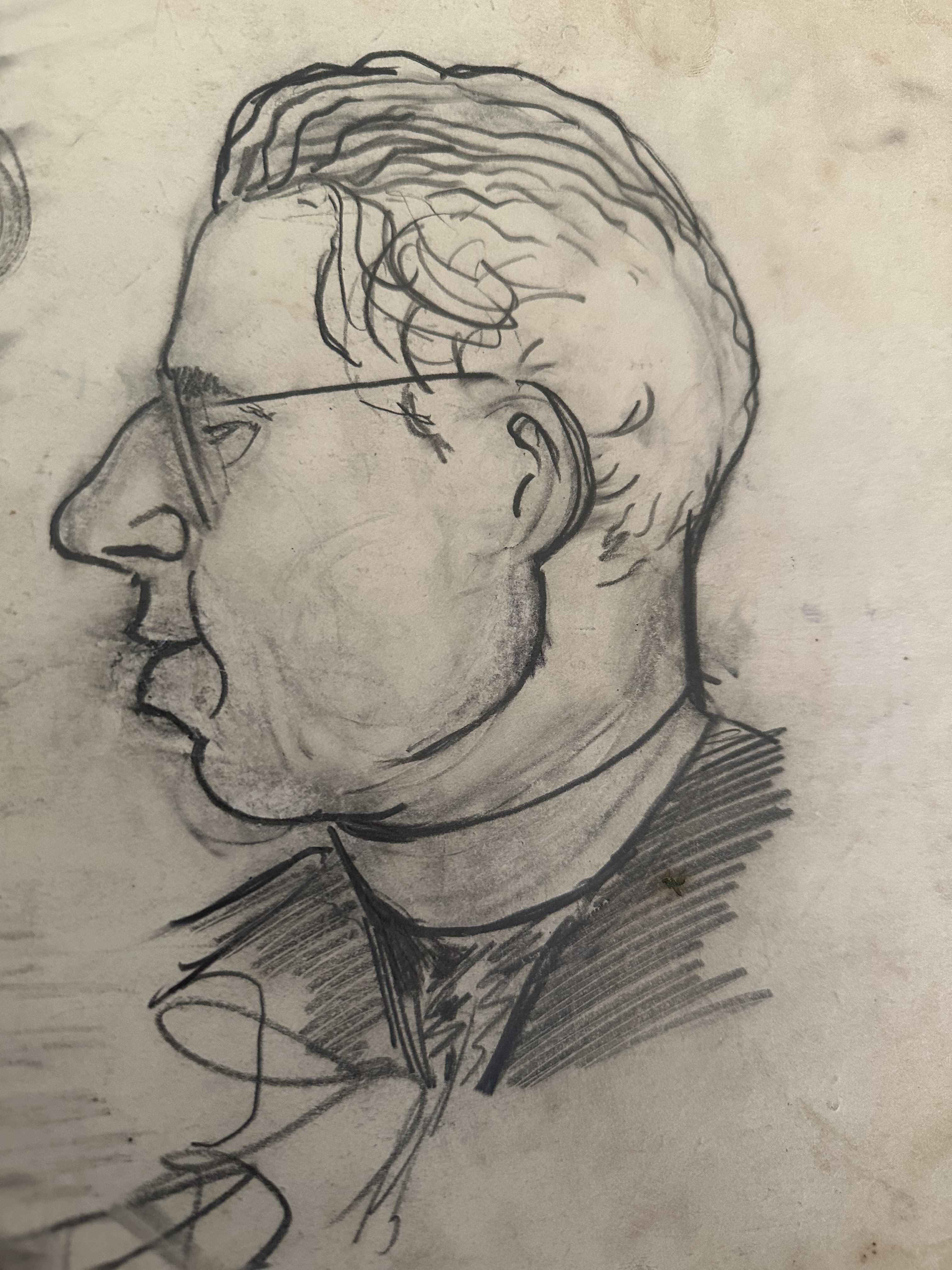
A notebookof his remains with his sketches and meal menus from scout camps in the 1950's.

Friday, 26 January 2024

The songs my father sang

Paulius Rutenis (Rutkauskas)

19 March 1919 – 28 August 1983

Singer, soloist, actor, director, journalist.

A man who was seen on and off stage in Adelaide, Melbourne and later Sydney.

He was born in Liepaja, Latvia, to Lithuanian parents who travelled there to work.  When he was around three years old, the family returned to Lithuania.  His father loved to sing and would encourage the whole family to sing together.  They would open the windows and hear the applause from their neighbours.  His father was tenor, his brother was a strong bass, his mother an alto and sister soprano, in a word, a full choir.  Friends, all singers would gather and sing, Lithuanian folk songs in their home.

 Paulius finished Kaunas Aušros boys school and then studied at Vytautas Didžiojo University.  He became a soloist with the Kaunas National theatre.  In 1943 he moved to Vienna where he studied at the Theatre Wissenshaft, then the following year moved to Austria where he joined the Innsbruck Opera. He then moved to Stuttgart where he sang on radio and would perform for Lithuanians in Displaced Persons Camps.  He was able to sing in five languages.

 Migrating to Australia, he arrived in Adelaide having traveled on the General Black on 3 June 1948.  He was sent to work on the railways at Peterborough, South Australia.  While in Peterborough he gave a concert at the Peterborough Town Hall with two other Baltic artists, a classical ballet dancer from the Berlin Wintergarten, Borys Schinkow, and Stasys Liaksas, piano  accordionist formerly of the American Army Officers' Club band.

 He actively involved himself in the Adelaide Lithuanian community and local music scene.  He could often be heard singing on the radio.  He organised the Lithuanian theatre group, where he acted and directed numerous plays.  He studied at the University of Adelaide for two years, leaving to move to Melbourne.  From 1966 he joined the Australian Opera where he had minor roles and sang in the Opera Choir. He retired in 1981.

In 1977 he moved to Sydney and joined the Sydney theatre group, Atžala where he acted and directed plays.  Shortly before his death, he formed the Sydney Lithuanian women’s ensemble Sutartinė. He commenced teaching them the songs he had learnt as a child from his father, long forgotten folk songs.

References

Australijos Lietuvis December 6th 1948 Nr.7

The Argus Thu 17 Jun 1948, page 3,  Three Baltic artists to give concert

Sunday, 10 January 2021

Dr Juozas Briedis

Dr Juozas Briedis was an agronomist who worked in Alytus, Seiniai, Ukmerge and Biržai before WWII.  He specialised in the economics of animal husbandry, deciding the most suitable type of breeds of stock for varying conditions.  He always had an interest in music and singing, such that he studied singing from 1937 – 8 at Kaunas Music School and later at the University of Bonn.  He led many choirs and vocal ensembles in Lithuania, Germany and the USA. 

On arrival in Australia, Juozas was sent to work as a labourer on the Metropolitan Water Sewerage and Drainage Board project, building the Warragamba Dam, which provides water supply to Sydney. 

When his two-year contract with the government
was almost complete, Juozas sought work in his profession.  He sent letters seeking employment to CSIRO and Sydney University.  The University would have employed him, but they could not offer remuneration equal to that of a camp steward of £12 per week. 

The construction of the dam was a large-scale operation that meant the establishment of its own town, houses with modern facilities.  Unmarried workers got a bed in a dormitory at a cost of 4 shillings per day.  New arrivals got to stay in tents until a house become available.  There was a communal refectory, but one could choose to make your own food.  There was post, some shops, and a cinema that showed films three times per week.  

The surrounding area is a eucalyptus forest three miles long, ending at Wallacia where there is a hotel, shops and restaurant.  The closest train station is Penrith, 16 miles away, from there to Sydney is another 30 miles.  Come the weekend the town empties of men who make their way to Sydney for the weekend.

Work varied, from constructing barracks, excavating soil, digging tunnels, blowing rocks and concreting.  The work week was 40 hours, some areas worked in three shifts.  A worker could earn £8-10 in a week depending on the work.  

Of the first Balts who arrived on 16 June 1948, four were Lithuanians.  The town kept growing and reached 3,000 workers, mostly migrants from Europe.  The dam has been renamed DiPi Dam, based on Displaced Persons.

With Juozas’ love of music and singing he organised a Lithuanian Men’s choir of seven men from the camp.  In 1949 he conducted the Regents Park Lithuanian Men’s Choir.  In September 1950 in Penrith, Juozas sang at a United Nations International concert in the Dungowan Theatre.  The choir organised a concert in Sydney of Lithuanian folk songs which they sang in national costumes.  It was broadcasted over radio.

He became involved in the Lithuanian community in Sydney.  He was Chairman of the Board of Lithuanian Catholic Centre and wrote for Mūsų Pastogė.   In 1951 he was Vice President of Krašto Valdyba.

In 1952 he moved to Chicago where he again became involved in the Lithuanian community there.  On leaving Australia he asked that people donate money to the church rather than the community hold a tea for him.   In 1960 he was Lithuanian School Choir leader in Lemont Illinois and participated in USA and Canada Song Festivals.  He owned his own paint business in Lemont.

He died on 2 February 1991 in Chicago.

Photo 30 Nov 1978 Dirva

Tuesday, 3 March 2020

Leonas Baltrūnas – the father of Australian Lithuanian sports


Born 20 October 1914 in Riga to Lithuanian parents.  He graduated Riga High School in 1934 and then attended the Kaunas War School graduating in 1937 in Physical Education. He became interested in basketball in 1935 when he met with Lithuanian basketball coach from America, Konstantinas Savickas.  At 6 foot 4 his height was an advantage and by 1936 he became a member of the Lithuanian National basketball team.  During his four years on the team he played 17 games and scored 31 points.  He played on the Central Junior Sports Organization (CJSO) team.

From 1937 to 1944 he was the Head of the Lithuanian Ball Games Basketball and Volleyball Teams.  He prepared the Kaunas national Basketball teams for competition with the USSR in an eight city competition in 1941. 

Leonas became a member of the gold winning Lithuanian National Basketball team, European championships held in Riga 1937 and in Kaunas two years later in 1939.

Towards the end of 1944, he fled to Germany.  While residing in Displaced Persons camps, Leonas was still very much active in basketball, volleyball, athletics and swimming in the Čiurlionis Sports team.

He arrived in Australia on the General Stewart on 13 April 1949.

Leonas continued his sporting interest in Australia where he was a great volleyball player.  He is a life member of the Victorian Volleyball Association and was at one time coach of the Victorian Volleyball Squad and also president of the Victorian Volleyball Association. 

The Lithuanian Physical Education and Sports Governing body in Germany FASKAS appointed Leonas as its representative in Australia.  He contacted other Lithuanian sportsmen in Australia and united them into one national sporting body.  He organised the first Australian Lithuanian Sports festival held in Melbourne in 1950.  Leonas resigned as the representative of FASKAS in 1951 and three years later the Australian Lithuanian Physical development Association ALFAS was born. He instigated the first Lithuanian Sports Club in Australia, Melbourne Varpas. He was committed to the team and coached basketball and volleyball. In 1955 he was elected Chairman of the Australian Lithuanian Physical Education Association.

From 1949 to 1953 he was Victorian State team basketball coach and player in 1955 Australian National Basketball team coach.  Later he worked at a lecturer at Swinburne Technical School in Hawthorn, Physical Education and Department of Sports.

Was a member of the Čiurlionis Ensemble and in Australia, he and former members founded the Melbourne Lithuanian choir.

In retirement he edited a book on Lithuanian athletes in Australia 1949-1979.

He died on 20 April 1993 in Melbourne.

Monday, 3 February 2020

Melbourne choir participates in the Toronto Song Festival, 1978


On June 23, 1978 the Melbourne choir, Samburys, left Tullamarine airport in Melbourne flying to Los Angeles.  There they were met by LA President, Vladas Simoliunas and billeted with local families.

The following evening in St Casimir’s church hall a meet and greet was held between the local community and sports delegates and choir singers. 

Disneyland was visited by many of the choir the next day.  

On June 25th the choir sang some songs at mass.  The first concert was held in the church hall amidst some trepidation and hope that their first concert on American soil would go well.  300 people came to the concert and the choir was met with a standing ovation, flowers and gifts.

A few words were said by Lithuanian Consulate Vytautas Cekanauskas, ‘ We are very thankful that you came and continue to uphold the Lithuania spirit’.  LA Community President spoke, “June is a painful month for us, why did you partake on such a long journey?  The answer we are seeking peace, strength and energy to a free Lithuania. There are many obstacles, lies deception and political sabotage.  We all need to fight.  Like birds who return from faraway places to home, we need to wait for spring to fly home”.

On 26 June they left Los Angeles for Toronto where they were met by Danutė Barauskaitė on behalf of the Toronto Lithuanian community.  The choir was again billeted, their first concert in Hamilton was performed to an audience of 400 people.  Every choir member received a pin and flag, and two books on Hamilton Lithuanians.

On the 29th Samburys sang to audience of 200.
30th June, they performed in a concert for Toronto Lithuanians for 400 people.

On the 2 July Samburys participated in a Song Festival, with 54 choirs and over 1400 singers and a 300 member children’s choir.
A motto was chosen for the festival from a poem of Pr. Lemberto

Is visų kraštų pasaulio vėjai neša mūs skundus
Duokite laisvės, duokite saules,
Leiskti grižti į namus.

From all corners of the world the wind carries our grievances
Give us freedom, give us sun
Let us return home.

The festival was held in the Maple Leaf Gardens stadium which could seat 16,000 people.

Friday, 16 March 2018

Ačiū Elena Pimpiene


Elena Pimpienė nee Šutaitė

Mano močiute, my grandmother, or čiute as we sometimes called her was a great part of my life.   Growing up my family would spend each Sunday with them and parts of the school holidays. We grew up with them speaking Lithuanian, with some English thrown in.  Looking back, I can see how much of their culture they passed on, but at the time they were just my grandparents.

Elena was born in a small village in the Dusetos region to a farming family.  Her early life was the farm and looking after her grandmother.  When she married my grandfather, they moved to Kaunas before making their way to freedom in Germany.  Their young daughter died on the way, but two more children were born in the camps.  After arriving in Australia, they settled in Adelaide, raising their two children.  The family over time exploded to in-laws and five grandchildren.

Močiute was a great cook, and food was always plentiful at her house.  You did not leave without being feed and taking some extra home with you.  There was always soup to start each meal, my favourite of course was barokų sriūba (beetroot soup). Then an assortment of Lithuanian dishes, meatloaf, sometimes cepelinai, cabbage rolls or kugelis.  Desserts were the best, napoleonas cake on special occasions, and hedhog cake she made us when we were small, even spirgai at times.  We once made krustai together, but I had a hard time flipping the pastry through the slits.  Once I asked her to teach me how to make cepelinai, but by the time I arrived she had put it all together.  

My grandparents back yard was really a huge vegetable garden with fruit trees scattered around.  They grew many of their vegetables; cucumbers, tomatoes, capsicums, carrots, which my family would receive bags full of when in season.  Also the fruit; apples, pears, mandarins, apricots, almonds when they came to fruit.  I love growing food as they did.

Being always industrious, močiute was a keen and very good seamstress.  She worked in clothing factories in Adelaide and was always at her sewing machine making clothes for someone.  On weekends there was often Lithuanian ladies sitting in her sewing room who came to get her measurements done or fitted for outfits.  She sewed the dresses for the Lituania choir, made scout dresses and even made our Lithuanian costumes.  She was inventive and given the time (1980’s), Lithuanian material wasn’t always available but its amazing what you could do with some ‘Lithuanian style’ curtains.  She embroidered my sisters and mine blouses and aprons with stylised tulips and geometric patterns.

My grandparents house was never cluttered, but the few things they had reminded them of their home.  Carved wooden tulips that surrounded the clock in the sitting room, a wooden carved hunter and tree, and the one picture that did hang in the dining room was taken on their wedding day so many years ago in Kaunas.  That picture hangs in my house now.

Weaving linen was a common practice in Lithuania and močiute grew up to be very good at it.  She told me as a young girl, she would get extra money weaving items for the local community.  She didn’t have a large loom in Australia, but my grandfather made her some small ones where she wove sashes and bookmarks.  She taught my mother to do the same and I asked her to teach me.  She instructed me on how to cast on, how to read the patterns how to make bookmarks, sashes and ties.

Linas & Elena's wedding day
My grandparents were involved in the Adelaide Lithuanian community, they went to church, attended some social events and came to all our school and dancing concerts.  It wasn’t until my grandfather passed that she stood on a committee, becoming at one time the President of the Pensioners Club.  She loved the outings, the bingo afternoons even when her eyes failed her she would still attend.  She volunteered for Meals on Wheels but never quite liked it, not because of the work or the people, but because of the dry scones they made for morning tea.
50th Wedding anniversary

Elena passed away in Adelaide in 2011, at the age of 97. 
Mano močiutė, instilled in me a love of her country, she taught me its language and showed me its beauty through her life.  For this I would like to say, ačiū močiutė.

The Pocius kids, dressed in Mociute made clothes and tauntinai rubai

Monday, 27 November 2017

USAT General Stuart Heintzelman - 70 years

Yesterday at the Adelaide Lithuanian House we celebrated the arrival of the General Stuart Heintzelman ship 70 years ago.  Below is the speech presented at the event.

 
World War II for many in Europe brought sweeping changes. For the Baltic States their independence of 22 years was crushed by Soviet Russians, during the months of June and July 1940. As the war progressed, the German Army replaced the Russians and by 1944, the reverse happened, the Germans were replaced once again by the Russians. It was at this time that many people left Lithuania, making their way west, to Germany.

The refugees became known as Displaced Person’s, or D.P’s.  

The displacement was thought to be temporary, that they would soon be able to return home. When the D.P’s realised that their return would not be in the near future they considered immigration.

Australia’s vulnerability of foreign invasion was highlighted during the Second World War. This fear combined with the desire of economic growth saw the introduction of a large scale immigration scheme, proposed by Arthur Calwell, the Minister of Immigration at that time.

It was hoped the scheme would attract British migrants, but this was not to be, as they were still feeling the repercussions of war, other sources were sought. The search for similar compatible people was found in the refugee’s camps of Europe.

Between 1947 and 1951, 54 000 Lithuanians were resettled around the world. Just over 10 000 came to Australia, 9906 came under the Government scheme, while 140 came unassisted. 

The General Stuart Heintzelman was the first ship that carried Displaced Persons from war torn Europe to settle in Australia. 

The General Heintzelman was commissioned first in the US Navy as a troop transport ship for Army personnel. At the end of 1946 the ship was converted to the DP operations in Germany and Australia.

The ship is named after US Army General Stuart Heintzelman, born in November 1876. He fought in WWI and was promoted to Major General in 1921, the rank he held until his death in 1935.

At 4:00pm on the 30th of October the ship General Heintzelman left the port of Bremehaven in Germany.


The first transport brought 843 refugees to Australia, 87% were men, 13% women. Lithuanians were the largest contingent, numbering 439, followed by 262 Latvians and 142 Estonians. The oldest on board was 40, the youngest 12 years old. 

A 15 page booklet was produced on board to commemorate the journey. On page 1 it is written;

We have ceased counting the days, which have passed since we lost sight of the European coastline. With each hour more and more miles increase the distance between us and the hopelessness and idleness in Germany, bringing us nearer to a new worthy life in a new land. We are animated by gratitude for the rehabilitation, which we are offered by the Australian Government in conjunction with the IRO. We are determined to become good citizens of our new country and we fervently desire to take once more our place in a community, which will accept us as its members, each one of us working to the best of our ability with regard to our individual aptitudes.

These abilities and aptitudes are a heritage from our native countries on the shores of the Baltic Sea, our only native countries for which there will always be a feeling of longing and reverence in our hearts. We are all sons and daughters of Estonia, Latvia and Lithuania and such we will remain, remembering with pride the prosperity and achievements that once were ours. The fate and sufferings of the Baltic peoples are known to the greater part of the world, to the rest we shall untiringly tell them until the day our native countries regain their freedom and independence.

This ship is a link between our distant native country and our new refuge. 

The booklet continues about daily activities on the ship

The days pass, one very much like any other, sunny and bright. Mealtimes with their inevitable queues, clatter of metal plates and thronging in the mess hall have become milestones in the course of each day. English lessons, choir rehearsals, basking in the sun and the mild wind fill the other parts of the day, and in the evening, we suddenly realise that one more day has passed.  

We can always be assured that each day our reliable engines are bringing us 400 miles nearer to our destination, where a new life and new responsibilities await us. We shall arrive there refreshed, tanned and imbued with renewed self reliance in our strength, impaired by the years of despair and misery in Germany. (Page 5)

On board, the Lithuanians formed a choir, published a news sheet called Baltic Vikings and commemorated All Saint's Day, and the Lithuanian Armed Forces Day on 23rd November. 

Before the departure of the first transport for Australia, Borisas Dainutis was authorised by both the Lithuanian Scouting movement and the International Scouting Bureau to organise and lead Lithuanian scouts in Australia. A scout leaders' committee meeting was held on 9 November 1947, on board the ship. The following day an order was created to establish a Scout Rovers troop (Skautų Vyčių Draugovė) incorporating all scouts. 

The first meeting of the Division was held on deck on 10 November 1947 with strong, emotional words. Dainutis reminded listeners of their purpose in Australia, of the importance of maintaining high scouting ideals for the sake of their homeland. The echoes of scout and folk songs resonated across the waves of the Red Sea, uniting all in friendship.

At a meeting on 15 November, the leaders discussed practical matters. It was decided to document personal and scouting details of all scouts and guides. Each scout unit was to study scouting theory and were to prepare a joint campfire with the Latvians and Estonians.  

25 years old Antanas Kanisauskas, was onboard that ship, he wrote a diary on the journey.

Antanas made Adelaide his new home. 

Shortly into the journey he wrote.

We are sailing on the Mediterranean Sea and only sea water and water, nothing else around us. Australia is still 3 weeks away. I am not certain I am doing the right thing, travelling so far. We will have to start from scratch.

On the 26th November, the day before arriving in Fremantle he wrote;

We will start a new life in a foreign country. This is something that I never thought of, to travel and live so far away.

Today my fellow travellers are cleaning up, showering and shaving before disembarking and tonight they organised a dance in the mess hall as a farewell. All the young people are dancing, happy to disembark in their new home country to be.

My mind always yearns for my own dear Lithuania where my family live. I will never forget my birth place, where I grew up.

The following day;

Thank God the journey has ended. Today in the morning we reached the shores of Australia. At 10:00 o’clock we disembarked. Almost immediately my thoughts have changed when I saw how people lived. Now I think that it was not a mistake to come to Australia.

The ship docked in Freemantle where the migrants spent a week before being placed on the ship Kanimbla sailing to Melbourne. Here they were met by Immigration Minister Arthur Calwell. Calwell told them that they would be undertaking hard jobs that Australians didn’t want. From the ship they were placed onto a train bound for the processing camp at Bonegilla.


The Lithuanians did not forget their homeland, this house where we meet is a testimony to that.

I can only imagine what it would be like to leave everything behind, to start again in a new country, with a new language, new culture. But this is what 10,000 Lithuanians did. They did not forget their homeland, their roots and their culture. They survived and prospered. And 70 years later, their children, grandchildren and great grandchildren say Aciu, thankyou, we are proud of you and we will not forget out roots.


Attending the event were four men who were on the ship. From left Jonas Kildisas,
Algimantas Pranckunas, Aleksas Saulius, Juozas Doniela


Below are some of the Lithuanians from that transport who settled in South Australia.

 
AKUMBAKAS
KALENDRA
 
ANTANAITIS
KALIKAS
 
BALSEVIČIUS
KAMISKAS
 
BAKŠYS
NORKELIŪNAS
 
BIELSKIS
MAZILIAUSKAS
 
BIMBA
NAVICKAS
 
BLIUKYS
PUŠLYS
 
BRAZAUSKAS
ŠALYTĖ
 
BULKĖ
SAMULIS
 
ČAPLIKAS
SMILGEVIČIUS
 
DEIMANTAS
STAUGAS
 
DONIĖLA
UZPULEVIČIUS
 
DZIAUGYS
VALIŪLIS
 
GRICIUS
VALENČIUS
 
GUOBA
VALTERIS
 
GUSTAINIS
VIDURGIRIS
 
JAKIMAVIČIUS
ZAJARSKAS
 
JANONIS
ŽVINKLYS
 
JUČIUS
 
 
JUODKA
 
 
JUŽELENAS


Sydney Real Estate Agent, Vaclovas Narbutas

Vaclovas Narbutas Vaclovas Narbutas, of 83 Enmore Street, Newtown, NSW (telephone LA 4791), worked as a house and business purchasing agent ...