Showing posts with label scouts. Show all posts

Friday, 21 February 2025

Algimantas Plūkas

Algimantas Plūkas was born on New Year’s Day 1922 in Kupiškis. He is the son of Ignas and Julija Aleknaite.  He attended primary school in Kupiškis from, 1936-1942. studied at Kupiškis gymnasium.  In the summer of 1944, he left Lithuania for Germany, he had been studying electronics and residing in Vilnius before he left.  He had hoped to migrate to Cleveland. On 30 October 1949 emigrated to Australia on the Nelly and settled in Sydney.

He worked in a private company as a silversmith. His work is held by the Australian Officers' Association in Sydney (miniature cannon valued at about $4,000), Cardinal Gilroy of Sydney (several).

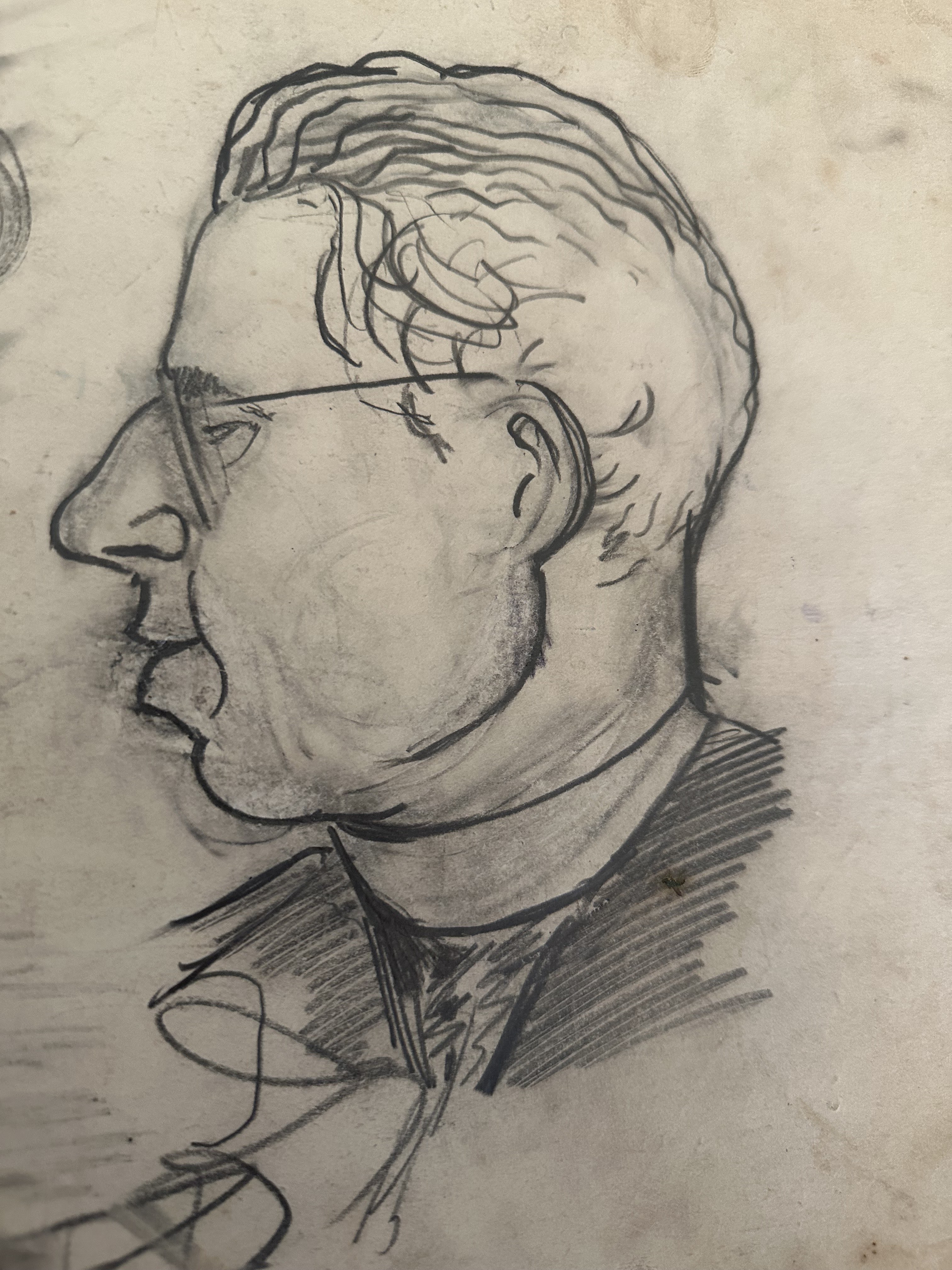
He devoted a lot of energy, time, financial resources and energy to Lithuanian affairs, he was a accordion player, conductor, instrumentalist, painter and decorator.  He carved wood, worked in metal.  He led the Sydney Lithuanian choir, Dainava from 1955 to 1957.  From 1960 to 1963 he led a double quartet, Rožytes, a double trio, the Merry Brothers. He wrote songs for scouts and guided groups. He illustrated Ava Saudargienė's book Sigutė (1968). He created a national dancing group called Plūktetas.

Algis joined the scouts in 1932 and gained his senior scout level in 1943. In Australia, he was a long-time member of the Sydney Lithuanian scout troop, Aušra and scouter leader. In 1952 he completed the Australian Scout Leaders Course, receiving the rank of Scoutmaster.  He participated in the 1938 national scout camp in Panemunė, Lithuania and led the Lithuanian scouts in the 1952-1953 Pan-Pacific Jamboree at Greystanes, NSW and almost every Aušra camp and district camp while in Australia.  Algis was an irreplaceable camp cook, musician and artist.  Camp songs composed by him are still sung today. For several years he illustrated the scout journal Pėdsekis.

He has been awarded the badge of the Tėvynės Sūnaus žymeniu Son of the Fatherland and the ordinu Už Nuopelnus Order of Merit for her services to scouting.

     Algis passed away on 11 June 1976 in Sydney. He has been interned in the Lithuanian section of Rookwood cemetery, Sydney. 

A notebookof his remains with his sketches and meal menus from scout camps in the 1950's.

Sunday, 16 January 2022

Albinas Pocius, the Lithuanian Minor Activist


Albinas was born on December 13th 1918, not far from Sėda. His parents were farmers. He finished Sėda Primary school and then the Sėda middle school. He first joined the scout movement  in 1930, as a 12 year old, an interest that he retained throughout his life.  Albinas attended high school in Mažeikas, but finished high school in Klaipėda.  He studied journalism at the Vytautas Didysis school.  During the soviet occupation Albinas worked on the railways.

In August 1944 he fled the Russian front and fled to the west.  He found himself in the Montomery camp in Dorverdene camp and later Seedorf, the British zone.   It was in a Seedorf Displaced Persons camp in Selsingen that he met Ruta Pociute whom he later married on the 23 March 1947.  

On February 1949 they left Naples on the boat Nea Hellas, bound for Australia.  Albinas spent his two work contract planting pine trees and later working in Housing Trust building homes.  The skills he learnt on the job allowed him to build his own home in Warragul. In 1949 he was actively involved in the Lithuanian scout movement and helped V.s B. Dainutis organise the Australian district.  He had been in Australia only one month before he sought out other Lithuanian scouts, corresponding with them.  

Albinas continued writing for various Lithuanian newspapers over the years.  He wrote “Po Svetimų Dangum” (Under a foreign sky) about scouts in the Sydney Lithuanian newspaper, Mūsų Pastogė.

Later Ruta and Albinas moved to Melbourne where they spend many years.  They became heavily involved in the Lithuanian community, Albinas in scouts, Ramovė even become president of the Australian Lithuanian and regional director of the Lithuanian Scout Association.  Albinas was Ramovės secretary and for six years was Vice-President of the Melbourne Lithuanian Club from 1968 to 1972.  For many years he was the Scouts Ramovė president and also held position of President of the Melbourne Lithuanian community for eight years and in 1980 was elected to the Australian Lithuanian community as President.  He was awarded the World Lithuanian community Karaliaus Mindaugas and Vilnius Universitetas 400m medal.  

Albinas became heavily involved in the fight with the Whitlam government acknowledgment of the Baltic states as being incorporated into the Soviet Union.  He joined the Australian Baltic Committee & Captive Nations and served on both as vice-president.

Albinas was very concerned with the plight of Mažoji Lietuva (Lithuania Minor) and wrote many articles and booklets on the situation.  He lectured extensively throughout Australia and Melbourne. In 1951 he organized the Mažosios Lietuvos Bičiulių Draugija, (Friends of Lithuanian Minor) and became the President.  

After retirement, the couple moved to Adelaide, as Ruta had family there.  Albinas involved himself in the Adelaide community and continued writing. 

In 1997 Albinas and Ruta celebrate their 50th wedding anniversary.  Family and friends gathered at Lithuanian House in Norwood for a lunch.  He passed away two years later in 1999. Mass was held in the Lithuanian chapel and later at the Centennial Park where he was cremated.  

Albinas was a big bulky bear of a man with a gentle soul.  He was softy spoken, well educated and a true Lithuanian patriot.  He dedicated many years of his life to the Lithuanian community, in the hope of seeing his country free again. 


Thursday, 19 March 2020

Leopoldas Kepalas - National Lithuanain Basketball player

Leopoldas Alfonsas Kepalas, son of Jonas and Elena Von Kulberg, born 6 Sept 1912 in Petrograd.  He returned to Lithuania with his parents in 1924 and lived near Kamajai near Rokiškis.  In 1926 he attended the Šiauliai school and was active in scouts.  He then entered the technical school in Kaunas and upon graduation moved to Vilnius where he was the Director of a soap factory. 

1927 – 1930 Šiauliu sports club member
1928 – 1931 Šiauliai and Kaunas  Aušros men’s team
1932 – 1935 Kaunas sports club Grandis1932 – 1939 Lithuanian Basketball league
1936 – 1937 Lithuanian national Basketball team
1945 Hanau Lithuanian basketball team
1947 Bayreuth Basketball team

He was selected for the 1937 Lithuanian basketball team to play in Riga.  He continued playing sports wile in Germany.  A keen scout from a young age he continued this also as part of the Hanau camp scouts and later in Australia part of Melbourne Džiugo tuntas.
He arrived in Australia in 1948 and while in the Bonegilla Migrant camp organised a basketball team.

He married and was survived by a son and daughter. 

He died 12 February 1981. Interned in Springvale Cemetery.

Monday, 23 April 2018

100 Aciu - Eddie Gudelis


Eduardas Gudelis
Eddie (Dad) was born May 4, 1940 in Kaunas.  His biological father, Jonas Kondrotas, was an officer in the Lithuanian army.   He was arrested, sent to Siberia and later died there.  Juze, dad’s mother, never knew what happened to her husband.  Antanas Gudelis was there for her at this difficult time.  She married him and adopted dad.

As a family, they lived in refugee camps until 1949 when they arrived in Australia.  The family first lived in a share house in the city (Kintore Avenue) whilst having a house built at 8 Princes St, Prospect.
From a young age he was involved within the Adelaide Lithuanian Community – scouting, as a member of the Žilvinas Dancing Group and he also played basketball for the “Vytis” Sports Club.  In his later years he was an ALB and Vytis Sports Club member.

In his formative years, he was an altar boy and also had a private Catholic education at the Christian Brother’s College.  He was quite rebellious and enjoyed wagging school and going to the movies or playing football with his mates.
His love of sport included playing and watching basketball which he was passionate about.  He instilled the love the game into me.  He drove me to basketball games as a teenager and was a vocal supporter from the sidelines.  Later on we had season tickets for Adelaide 36’ers games for years.

His first love was basketball until he met mum and they had two daughters Kristina and Natalie.  Dad was very family orientated and every weekend we visited “Babytė” and “Senelis” and went to Sunday mass.
He was a quiet, selfless and caring person always thinking of others before himself.  He also had a dry sense of humour.

He instilled in me an interest in the Lithuanian community of which I am still involved.
Dad made sure both Nat and I worked hard for what we wanted and instilled in us the value of being humble about our achievements.

Submitted by his daughter, Kristina.

Wednesday, 28 February 2018

Ačiū Petras Bielskis

Petras BIELSKIS


Petras was born March 23, 1927 in Biržiai, Lithuania.  There he attended high school, as well as business college.
In 1944 he moved to Germany, and after the war, he finished Lithuanian High School, and belonged to the Lithuanian scouts and the Christian Youth (Ateitininkai) groups.

In 1948, Petras arrived in Australia on the General Sturgis, landing in Sydney. He joined the Sydney Australian Lithuanian Draugija.
In 1950, after finishing his compulsory work requirement, he arrived in Adelaide in March.

In 1952 he married Valė Jureviciutė.  After that, four daughters were born – Rūtą, Dalė, Audrė and Ireną.
Over the years, he became very involved in Adelaide and Australian Lithuanian community activities:

Firstly in 1950 – Petras became an Australian Lithuanian Community member and started fundraising funds to build the Adelaide Lithuanian House in Norwood.
In 1962-63 he joined the ALB Weekend (Savaitgalio) Lithuanian school parent committee.

In 1964-65 he joined the ALB Lithuanian Union (Sajunga) as treasurer. This was the organisation that looked after Adelaide Lithuanian House and its affairs.
1965-89. Then for the next 24 years, he was the president of the ALB Lithuanian Sajunga Inc.  He was responsible for negotiating the purchase of the house and land next to Lithuanian House that Petriukas Andrijaitis (caretaker in that era) lived in for many years.

1972-79 Petras also joined the Adelaide Vilniaus Scout Parents Committee and was its president for 7 years.
1971-90 Also for 19 years, Petras became the editor of the local Adelaide Lithuanian News (Adelaidės Lietuvių Žinios) newsletter. This was published regularly and distributed throughout the community to share the local news, upcoming events and write-ups of the many activities that occurred in the community. 
He wrote it up back then on a typewriter, cut and pasted it together by hand, before printing it with a small team of helpers in his home in a room especially set up to be a small publishing press.  It was then moved to Lithuanian House where a new photocopy machine was set up! 

From 1966, Petras also became a board member of the Australian Lithuanian (ALB) Council, and an ALB Honorary Judiciary member and then its president. 
In 1980-81 and 1999-2000 he was the president of the ALB Australian Lithuanian Council (Taryba) which is the official Australian Lithuanian Governing body that makes all the decisions for the Australian Lithuanian Community and links Australia and Lithuania.
In 1999-2000 Petras also became the vice-president of the Australian Lithuanian Board of Directors (Krašto Valdyba.)

Petras was also chosen as one of Australia’s representatives to attend the World Lithuanian Parliament in 1988 in Montreal, Canada, and in 2000 and 2003 in Vilnius, Lithuania.

In 2000-03 he was a member of the World Lithuanian Honorary Judiciary.
Finally, in 2010-14 at the age of 82, Petras became the president of the ALB Adelaide District Control Commission (Apylinkės Kontrolės Komicija).

Now in 2018, Petras Bielskis has turned 90 years old, and still is an active participant in Adelaide Lithuanian Community life and functions. 
His passion for the Lithuanian Community, his active involvement in many organisations over the years in Adelaide, Australia and Lithuanian earnt Petras Bielskis the V16 Order and Medal “Už Nuopelnus Lietuvai “from the Government of the Republic of Lithuania in 2003.

My father Petras Bielskis demonstrated a deep feeling for Lithuania. His involvement within the Adelaide, Australian and Lithuanian communities helped instil a strong bond for myself, and the rest of my family. We have, as a result, maintained strong links with the Lithuanian communities in South Australia, Australia and Lithuania.
Ačiū Tėtę!

Submitted by his daughter, Ruta.
Petras with Vladas Adamkus in centre

Monday, 27 November 2017

USAT General Stuart Heintzelman - 70 years

Yesterday at the Adelaide Lithuanian House we celebrated the arrival of the General Stuart Heintzelman ship 70 years ago.  Below is the speech presented at the event.

 
World War II for many in Europe brought sweeping changes. For the Baltic States their independence of 22 years was crushed by Soviet Russians, during the months of June and July 1940. As the war progressed, the German Army replaced the Russians and by 1944, the reverse happened, the Germans were replaced once again by the Russians. It was at this time that many people left Lithuania, making their way west, to Germany.

The refugees became known as Displaced Person’s, or D.P’s.  

The displacement was thought to be temporary, that they would soon be able to return home. When the D.P’s realised that their return would not be in the near future they considered immigration.

Australia’s vulnerability of foreign invasion was highlighted during the Second World War. This fear combined with the desire of economic growth saw the introduction of a large scale immigration scheme, proposed by Arthur Calwell, the Minister of Immigration at that time.

It was hoped the scheme would attract British migrants, but this was not to be, as they were still feeling the repercussions of war, other sources were sought. The search for similar compatible people was found in the refugee’s camps of Europe.

Between 1947 and 1951, 54 000 Lithuanians were resettled around the world. Just over 10 000 came to Australia, 9906 came under the Government scheme, while 140 came unassisted. 

The General Stuart Heintzelman was the first ship that carried Displaced Persons from war torn Europe to settle in Australia. 

The General Heintzelman was commissioned first in the US Navy as a troop transport ship for Army personnel. At the end of 1946 the ship was converted to the DP operations in Germany and Australia.

The ship is named after US Army General Stuart Heintzelman, born in November 1876. He fought in WWI and was promoted to Major General in 1921, the rank he held until his death in 1935.

At 4:00pm on the 30th of October the ship General Heintzelman left the port of Bremehaven in Germany.


The first transport brought 843 refugees to Australia, 87% were men, 13% women. Lithuanians were the largest contingent, numbering 439, followed by 262 Latvians and 142 Estonians. The oldest on board was 40, the youngest 12 years old. 

A 15 page booklet was produced on board to commemorate the journey. On page 1 it is written;

We have ceased counting the days, which have passed since we lost sight of the European coastline. With each hour more and more miles increase the distance between us and the hopelessness and idleness in Germany, bringing us nearer to a new worthy life in a new land. We are animated by gratitude for the rehabilitation, which we are offered by the Australian Government in conjunction with the IRO. We are determined to become good citizens of our new country and we fervently desire to take once more our place in a community, which will accept us as its members, each one of us working to the best of our ability with regard to our individual aptitudes.

These abilities and aptitudes are a heritage from our native countries on the shores of the Baltic Sea, our only native countries for which there will always be a feeling of longing and reverence in our hearts. We are all sons and daughters of Estonia, Latvia and Lithuania and such we will remain, remembering with pride the prosperity and achievements that once were ours. The fate and sufferings of the Baltic peoples are known to the greater part of the world, to the rest we shall untiringly tell them until the day our native countries regain their freedom and independence.

This ship is a link between our distant native country and our new refuge. 

The booklet continues about daily activities on the ship

The days pass, one very much like any other, sunny and bright. Mealtimes with their inevitable queues, clatter of metal plates and thronging in the mess hall have become milestones in the course of each day. English lessons, choir rehearsals, basking in the sun and the mild wind fill the other parts of the day, and in the evening, we suddenly realise that one more day has passed.  

We can always be assured that each day our reliable engines are bringing us 400 miles nearer to our destination, where a new life and new responsibilities await us. We shall arrive there refreshed, tanned and imbued with renewed self reliance in our strength, impaired by the years of despair and misery in Germany. (Page 5)

On board, the Lithuanians formed a choir, published a news sheet called Baltic Vikings and commemorated All Saint's Day, and the Lithuanian Armed Forces Day on 23rd November. 

Before the departure of the first transport for Australia, Borisas Dainutis was authorised by both the Lithuanian Scouting movement and the International Scouting Bureau to organise and lead Lithuanian scouts in Australia. A scout leaders' committee meeting was held on 9 November 1947, on board the ship. The following day an order was created to establish a Scout Rovers troop (Skautų Vyčių Draugovė) incorporating all scouts. 

The first meeting of the Division was held on deck on 10 November 1947 with strong, emotional words. Dainutis reminded listeners of their purpose in Australia, of the importance of maintaining high scouting ideals for the sake of their homeland. The echoes of scout and folk songs resonated across the waves of the Red Sea, uniting all in friendship.

At a meeting on 15 November, the leaders discussed practical matters. It was decided to document personal and scouting details of all scouts and guides. Each scout unit was to study scouting theory and were to prepare a joint campfire with the Latvians and Estonians.  

25 years old Antanas Kanisauskas, was onboard that ship, he wrote a diary on the journey.

Antanas made Adelaide his new home. 

Shortly into the journey he wrote.

We are sailing on the Mediterranean Sea and only sea water and water, nothing else around us. Australia is still 3 weeks away. I am not certain I am doing the right thing, travelling so far. We will have to start from scratch.

On the 26th November, the day before arriving in Fremantle he wrote;

We will start a new life in a foreign country. This is something that I never thought of, to travel and live so far away.

Today my fellow travellers are cleaning up, showering and shaving before disembarking and tonight they organised a dance in the mess hall as a farewell. All the young people are dancing, happy to disembark in their new home country to be.

My mind always yearns for my own dear Lithuania where my family live. I will never forget my birth place, where I grew up.

The following day;

Thank God the journey has ended. Today in the morning we reached the shores of Australia. At 10:00 o’clock we disembarked. Almost immediately my thoughts have changed when I saw how people lived. Now I think that it was not a mistake to come to Australia.

The ship docked in Freemantle where the migrants spent a week before being placed on the ship Kanimbla sailing to Melbourne. Here they were met by Immigration Minister Arthur Calwell. Calwell told them that they would be undertaking hard jobs that Australians didn’t want. From the ship they were placed onto a train bound for the processing camp at Bonegilla.


The Lithuanians did not forget their homeland, this house where we meet is a testimony to that.

I can only imagine what it would be like to leave everything behind, to start again in a new country, with a new language, new culture. But this is what 10,000 Lithuanians did. They did not forget their homeland, their roots and their culture. They survived and prospered. And 70 years later, their children, grandchildren and great grandchildren say Aciu, thankyou, we are proud of you and we will not forget out roots.


Attending the event were four men who were on the ship. From left Jonas Kildisas,
Algimantas Pranckunas, Aleksas Saulius, Juozas Doniela


Below are some of the Lithuanians from that transport who settled in South Australia.

 
AKUMBAKAS
KALENDRA
 
ANTANAITIS
KALIKAS
 
BALSEVIČIUS
KAMISKAS
 
BAKŠYS
NORKELIŪNAS
 
BIELSKIS
MAZILIAUSKAS
 
BIMBA
NAVICKAS
 
BLIUKYS
PUŠLYS
 
BRAZAUSKAS
ŠALYTĖ
 
BULKĖ
SAMULIS
 
ČAPLIKAS
SMILGEVIČIUS
 
DEIMANTAS
STAUGAS
 
DONIĖLA
UZPULEVIČIUS
 
DZIAUGYS
VALIŪLIS
 
GRICIUS
VALENČIUS
 
GUOBA
VALTERIS
 
GUSTAINIS
VIDURGIRIS
 
JAKIMAVIČIUS
ZAJARSKAS
 
JANONIS
ŽVINKLYS
 
JUČIUS
 
 
JUODKA
 
 
JUŽELENAS


The Canadian Lithuanian Nightingale captivates Australia

 In 1979, renowned Canadian Lithuanian soprano Gina Čapkauskienė captivated Lithuanian communities across Australia with a series of unforge...