Showing posts with label Kubilius. Show all posts

Wednesday, 21 September 2016

Farewell picnic for Father Jatulis

Picnic at Christies Beach

On a Sunday afternoon on the 25 August 1957,over 400 Lithuanians gathered at the Caritas property at Christies Beach for its first picnic and blessing of the house. Mass was said by Father Jatulis whose sermon emphasised a common house, common work. The choir, Lituania even came and sung. 
Not sure if this photo is of the actual event described but it was taken at Christies Beach

After mass, tables were set up, placed in rows and the Women’s committee brought out the home made, lovingly prepared food.  The occasion also served as a farewell to priest Paulius Jatulis who had been summoned by the church to go to Italy. 

Speeches were spoken every head present, from by ALB President, Stasys Čibiras, Theatre group head, Juozas Gusčius, Youth group leader Juozas Lapšys, Lithuanian Society President, J. Raginis, Scout Leader Vytas Neverauskas, Sports President J. Jaunutis and Ateininkai head, A. Kubilius. Instead of a farewell gift, the community gathered over £100 for Jatulis for his new path in life.  All present sand Ilgiausiu metų (Longest Years, sung on any special occasion) followed by more singing and joking before those present made the long journey back to Adelaide.

Monday, 18 July 2016

A blazing flag


Flags afire
Burning a country's flag is seen as a hostile action, displaying disrespect to the country.  It is often at demonstrations that this is done, giving the occasion a dramatic show.

In 1972, Adelaide Lithuanians burnt a Russian flag on the steps of Lithuanian House.  As the flames three feet high engulfed the flag, Lithuanians sang the Lithuanian National Anthem.   The flag burning came at the end of a city demonstration by Lithuanians in tribute to Romas Kalanta who burnt himself to death in Kaunas in opposition to Russian occupation. 
About 600 people packed into 150 cars for the motorcade demonstration through the city streets. Most cars carried banners decrying Russian opposition.

On the steps of Lithuanian House, Zita Bielskis, Rasa Kubilius and Jura Vitkunas poured petrol over the flag while Linas Varnas set fire to it.

Tuesday, 22 April 2014

Mothers day at the Lithuanian Catholic centre 1970.

Motinos diena 1970

Following mass by father Spurgis, the community gathered in the hall.  All mothers received a flower to pin to their tops, then were seated at the tables and offered refreshment by the students.

A program followed.  The school principal, K Pažėra, The Parish council member B. Dičiūnas, Lithuanian Catholic women’s president T. Gasiunienė and Ateitininkas (Catholic Youth)  member A. Kubilius spoke.  A picture of the Aušros Vartų Marija[i] (Gates of Dawn Mary) and fresh flowers decorated the stage where the children performed. 

Poems were recited by Vincas Bagušauskas, Viktoras Dunda, Kristina Stankevičiutė, Andrius Vitkūnas, Brigita Paul, Edis Jučius and Aidas Kubilius.  Further poems were read by Regina Pranskūnaitė, Sietynas Kubilius, Petras Urnevičius and Saulius Kubilius. 

R. Kubiliutė, one of the teachers lead the children in singing.  Regina Pranskunaitė and Ramunė Varnaitė played the piano. 

Older student, Linas Kubilius read an extract from Vaizgantis[ii] and Gintaras Kubilius  read Father Krasauskas thoughts on mothers.

The same day the Women’s committee organised a concert at Lithuanian House, performed by the Adelaide Lithuanian school. 


[i]  The Chapel in the Gate of Dawn contains an icon of The Blessed Virgin Mary Mother of Mercy, said to have miraculous powers.  For centuries the picture has been one of the symbols of the city and an object of veneration for both Roman Catholic and Orthodox inhabitants. Thousands of votive offerings adorn the walls and many pilgrims from neighbouring countries come to pray in front of the beloved painting.

[ii] Juozas Tumas, also known by the pen name Vaižgantas (September 20, 1869 - April 29, 1933), was a prominent Lithuanian writer, Roman Catholic priest, social activist, literary historian, and one of the founders of the Party of National Progress. He wrote novels, short fictional pieces, and non-fiction. His most notable works include the novel Pragiedruliai (Rays of Hope) and the narrative Dėdės ir dėdiėnes (Uncles and Aunts). Tumas is considered one of the most important Lithuanian writers of his era.

Wednesday, 25 September 2013

Summer youth camp, 1970

The Catholic organised a summer youth camp from 2 to 14th of January at ‘Kurša’ the Latvian camp grounds at Aldinga beach.  It wasn't the best place for a camp site as it was a bit far from the beach and the breezes cool. 

The camp was lead by Nemira Masiūlytė, assisted by R. Kubiliutė. Camp commandant was D. Karpys, camp cook was Visockiene, Janilionienė and Marcinkevičiutė.  Every evening father Kazlauskas and Father Spurgis would hold readings and discussions.  Guests spoke on various topics, L. Pakalnis spoke about Lithuanian poetry, A Kubilius spoke about practical Catholicism, M. Gavienienė about catholic ideology, V. Straukas and Father Spurgis led a discussion of youth issues, G. Kaminskas spoke on the Lithuanian language.  V. Vosylius gave a slide show featuring Lithuanian scenes.  P. Pusdešris spoke on and led a traditional partisan evening with a crown of flowers being let out to sea.
There were 25 children at the camp, with five of them had travelled from Melbourne.

The final day of camp, Father Kazlauskas said mass, followed by the youth showing what they had learned throughout the camp, singing national dancing, recitals. 

Monday, 16 September 2013

Mother's Day concert 1970

It has become traditional for a Mothers day concert to be held by the Adelaide Lithuanian community.  When there were two schools, there were two concerts.  St Casimir’s school children held a concert after Father Spurgis had given mass. The children all marched into the church hall to pin a flower to their mother as they sat by the tables ready for the concert.

A welcome was given by the school principle K. Pažera, followed by B. Dičiūnas on behalf of the Catholic centre. Lithuanian Catholic Women’s president, Teresė Gasiunienė and A. Kubilius also spoke briefly.

Aušros Vartu Marijos (The gates of dawn holy Mary) and live flowers decorated the stage. Poems were recited by Vincas Bagušauskas, Viktoras Dunda, Kristina Stankevičiutė, Andrius Vitkunas, Brigita Paul, Edis Jucius, and Aidas Kubilius.  Regina Pranskūnaitė, Sietynas Kubilius, Petras Urnevičius and Saulius Kubilius recited more poems.  In between the children’s choir sang, and teacher, R. Kubiliutė sang a song about mothers.  Regina Pranskunaitė and Ramunė Varnaitė played the piano.  Also present were senior Catholic Youth, Linas Kubilius who read part of Vaižgantis writings and Gintaras Kubilius read Father Krasauskas thoughts about mothers. 

Juozas Tumas, also known by the pen name Vaižgantas (September 20, 1869 - April 29, 1933), was a prominent Lithuanian writer, Roman Catholic priest, social activist, literary historian, and one of the founders of the Party of National Progress. He wrote novels, short fictional pieces, and non-fiction. His most notable works include the novel Pragiedruliai (Rays of Hope) and the narrative Dėdės ir dėdiėnes (Uncles and Aunts). Tumas is considered one of the most important Lithuanian writers of his era.


A mother’s day concert was also held at Lithuanian House on the same day.

Sunday, 17 March 2013

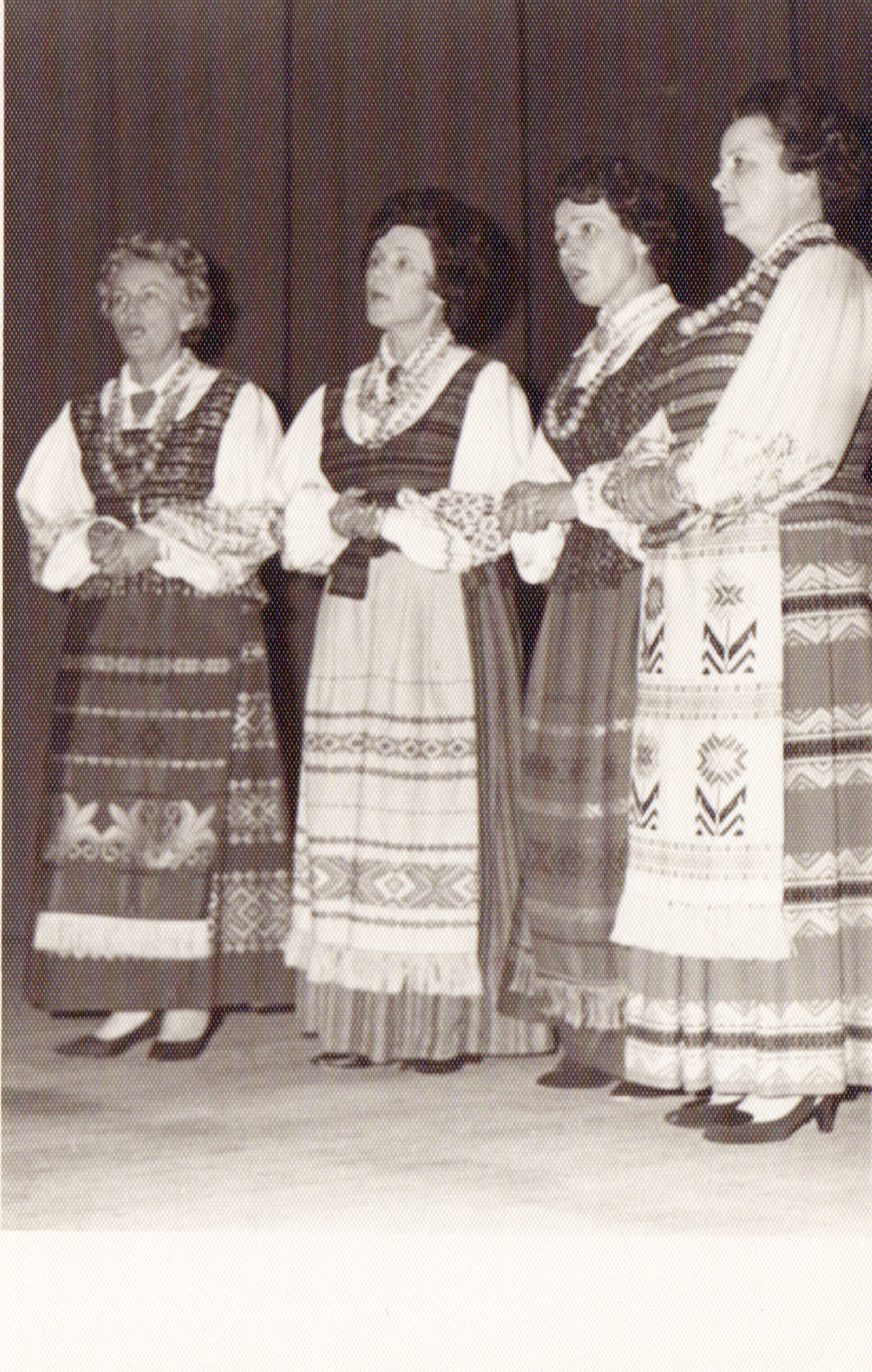
Nemuno Dukros (Daughters of Nemunas)

Uršulė Juciene, Anelė Urnevičienė,
Birutė Budrienė, Teresa Gasiunienė

Kur bėga Šešupė, kur Nemunas teka
Tai mūsų tėvynė, graži Lietuva

(Where the Šešupė runs, where the Neman flows That's our homeland, beautiful Lithuania)
Almost every Lithuanian can recite these words by heart. It is so well known that it is treated as an unofficial national anthem.

The Adelaide Lithuanian Catholic Women from 1961 organised an annual “Šupini” (mixed concert).  The women wanted to strength these concerts with Lithuanian songs and so a women’s vocal quartet was formed.  It was led by Anelė Urnevičienė.

The quartet first performed on May 15th 1965.  The group comprised of Birutė Budrienė, Uršulė Juciene, Teresa Gasiunienė (soprano), and Anelė Urnevičienė (Alto).  They were accompanied on the piano by Nemira Masiulytė Stapleton.

The group was a great success and so began to perform at festivals, literature evenings, gatherings, national festivals, at Baltic gatherings and at the Baltic homes.

On occasion they became a quintet with soprano Agota Kaminskienė. On other occasions N. Urmerienė and N. Vitkunienė joined them.

In 1971 they released an album of 16 songs, the record was called “Rankšluostiniausiu Lietuva Tėvyne”. They chose the name of Nemuno Dukros (Daughters of the Nemunas).  Performing on the album were members Birutė Budrienė, Agota Kaminskiene, Uršulė Jucienė, Anelė Urnevičienė The first side was accompanied Rasa Kubilius and the second  by Nemira Masiulytė. J Česna produced it, the covering photo was taken by A. Budrys, cover design by Pranas Pušdešrys and Administrator was P. Gasiunas, advisor was soloist A. Gučiuvienė.  The record was launched at the Lithuanian Catholic centre on February 22, 1972.

At various times the group was accompanied by Nemira Masiulyte-Stapleton, Rasa Kubiliutė-Mauragienė, Maria Dumčiuviene, R. Ziukelytė, Svietynas Kubilius, R. Pranckunaitė, S. Vasilauskienė, Dalia Kaminskienė, Father A Savickas, R. Kubaitienė, Algis Laurintaitis, and organ player J. Ramanauskas.

In 1975 Uršulė Jucienė left the group and Saulenė Pusdešrienė joined.  It was again a quartet which remained until 1981.  During that year Anelė Urnevičienė left and Saulenė Pusdešrienė became leader. In 1984 two young singers joined, Judita Nekrošius and Zinaida Vencius. Now a quintet they sang where they were asked and required.

On 30 November 1985 at the Lithuanian Catholic Centre a concert was held to celebrate the 20th year of the group.  Birutė Budrienė, Agota Kaminskienė, Judita Nekrosienė, Zinaida Vencienė sang with Saulenė Pusdešrienė as Manager.  Also performed was Sietynas Kubilius who gave a recital.  While the singers rested their husbands poet Kazimieras Kaminskas recited a poem and Pranas Pusdešris spoke.  Pranas also made the stage decorations. The concert was choreographed by Elena Varnienė.

In 1986 the choir was invited to perform at Melbourne’s Lithuanian catholic Women’s 35th anniversary.  They were accompanied by Zita Prašmutaitė.

Another Nemuno Dukros concert was given on December 9th 1989 with the same quintet as previously, the same manager and accompanist.  Twenty eight songs were sung, the first half was called Nemuno kloniais (Nemunas hollows) and Tėvynės laukais (fields of homeland).  The second half ‘Ilgesio dainos’ (songs of longing) and Lietuva širdyje nešu (Lithuania, I carry you in my heart).

Pranas Pušdesris wrote of them
Gyvuokite, dainuokite ‘Nemuno Dukros’, išeiviškos nostalgijos pagimdytos, ją sugebančios perduoti savo dainose, kad mes vis giliau pasinėrę svetimybių jūroje, nepamirštume Nemuno ir Tėvynės, aušros nušviečiamais keliais. 

Following her husband’s death in 1991 Saulenė Pusdešrienė hesitated to continue. Birutė Budrienė is the only singer who has sung since the group was conceived. 

Nemuno dukros sing songs of longing, they celebrated Lithuania’s independence but in their heart the pain of living over 50 years without being able to return to their homeland still exists.

The daughters of Nemunas sang well in to the 2000’s.
Uršulė Juciene, Anelė Urnevičienė,
Birutė Budrienė, Teresa Gasiunienė
Accompanied by Rasa Kubiliute


1.  Nemunas is the largest river in Lithuania.  It flows through Lithuania before draining into the Curonian Lagoon and then into the Baltic Sea at Klaipėda.  It is the northern border between Lithuania and Russia's Kaliningrad Oblast in its lower reaches.  

The names behind the Lithuanian Business, Maistas continued...

Jonas Šlyteris Jonas Šlyteris was born on 29 August 1895 in Smunkučiai village, Jurbarkas district, Lithuania. During the First World Wa...